How to Match Root Depth and Spread to Garden Space
Match root depth and spread to beds, containers, and neighboring crops to choose a planting place with enough usable soil space for healthy growth.
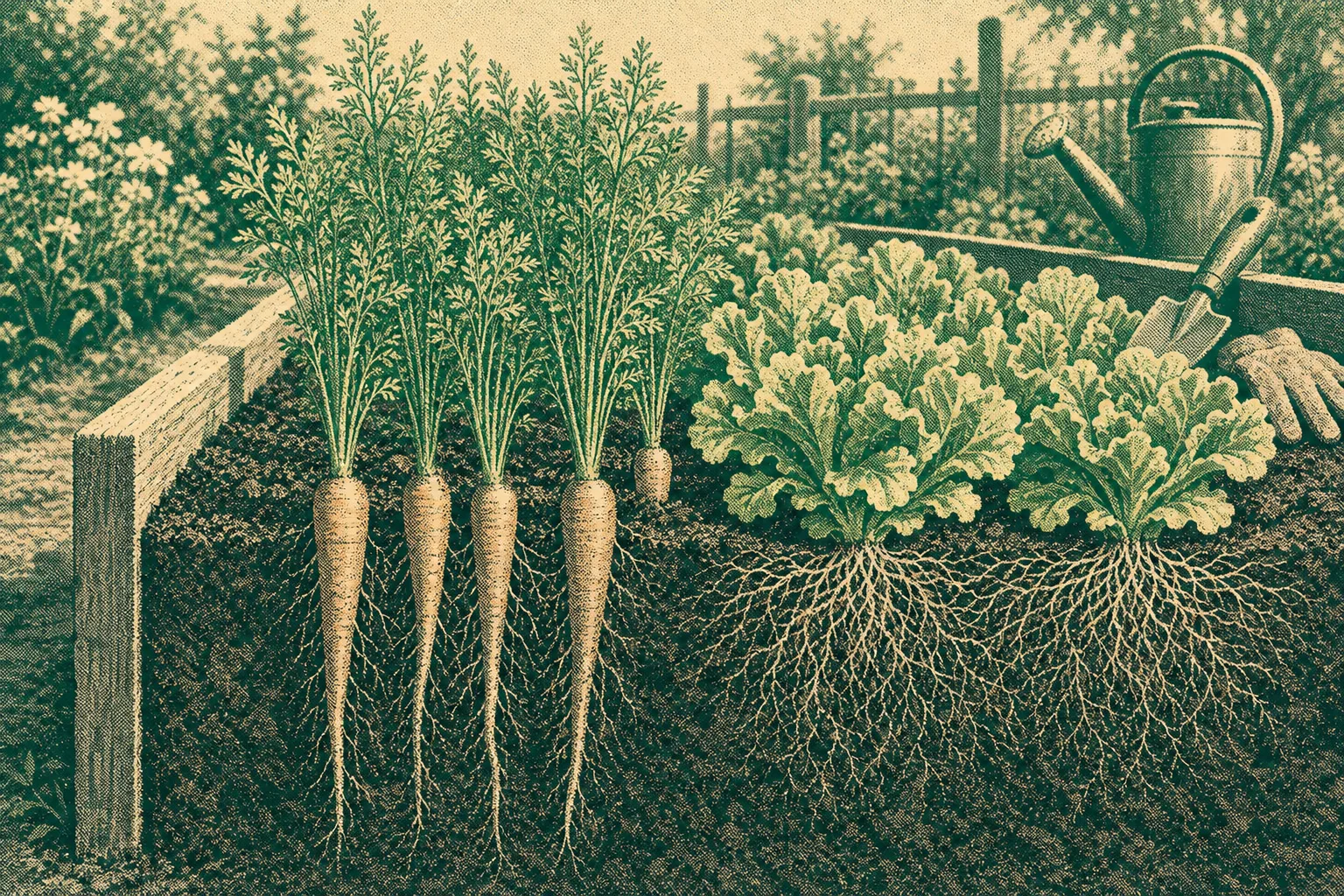
Root depth and spread should shape where you plant, not just how far apart you set seedlings. Matching root depth and spread to garden space helps you place carrots where their roots can grow downward and give lettuce room for its dense, near-surface network.
Root depth and spread vary with plant and soil
Terms such as deep-rooted, shallow-rooted, and spreading describe common patterns, not fixed blueprints. Roots may extend farther through loose, moist soil than through a compacted layer, while a pot wall can redirect growth that might otherwise continue outward.
A taproot is a prominent main root that grows downward, often with smaller side roots. Carrots and parsnips are familiar examples. A fibrous root system consists of many similarly sized roots that branch into a dense network; grasses and many leafy vegetables develop this pattern. Some plants combine a deeper framework with broad lateral roots.
Fine roots and their tiny extensions absorb much of the water and nutrients a plant uses. They can occupy soil beyond the visible base of the stem, so a plant’s root zone—the soil volume its roots use—is not neatly outlined by its leaves.
Match bed space to how each crop grows
In open ground, start with the mature spacing guidance on the seed packet or nursery label, then account for the crop’s likely root pattern and the soil. Check whether the spacing refers to plants within a row, rows, or mature plants. This guidance is a useful starting point, but it does not describe every underground need.
- Long, downward roots: Check whether the bed has loose soil and an unobstructed path below the planting area. If it does, sow the root crop there; if stones or a dense layer block that path, remove the obstacle where practical or choose a deeper growing space.
- Dense, shallow roots: Check whether the soil surface and canopy have room to fill in. If they do, plant the crop with its recommended spacing; if leaves will overlap heavily, thin seedlings or move them farther apart.
- Broad lateral roots: Check whether nearby plants will compete for the same soil area. If the bed has room, leave space beyond the stem; if it does not, choose a smaller neighboring crop or another location.
- Woody perennials and shrubs: Check the plant’s mature-size guidance rather than treating its nursery root ball as its full future footprint. If the site can accommodate that growth, plant there; if not, choose a more suitable spot or ask a local nursery about a container option.
- Mixed crops: Check whether neighboring plants have compatible watering needs as well as suitable spacing. If they do, group them in the same bed; if one prefers a drier root zone, place it elsewhere so watering one crop does not disadvantage the other.
- Close seedlings: Check the packet’s thinning directions and look for seedlings growing tightly together. If they are crowded, thin or transplant where appropriate; if they already have the recommended room, leave them in place and monitor their growth.
Say you have a narrow raised bed with loose soil, no visible stone layer, and room for one row of carrots beside lettuce. In this invented situation, the carrot packet describes a long-rooted variety, and the lettuce label gives mature spacing. You place the carrot row where its roots have a clear downward path, then position the lettuce according to its label and check whether its leaves will crowd the row. If the two crops fit without crowding, keep both in the bed; if the available width presses the lettuce against the carrots, move the lettuce to a separate planter instead.
Choose container depth and width for the crop
A container sets firm boundaries, so both depth and width matter. A deep, narrow pot can suit a crop with downward-growing roots but may constrain one that spreads laterally. A shallow, wide planter offers more surface area but may not provide enough soil for a crop that needs depth.
For root vegetables, check the mature root length or shape described on the seed packet, then compare it with the pot’s usable depth. If the crop can fit in loose potting mix, sow it there; if the container is too shallow, choose a deeper one or a shorter-rooted variety. For leafy crops, check whether the planter offers enough surface area for the mature canopy; if it does, follow the label spacing, and if it does not, use a wider container or fewer plants.
Use drainage holes and potting mix made for containers. Garden soil can become dense in a pot, while roots need both water and air. A small pot can dry quickly as roots occupy its mix; an oversized pot can remain wet longer than a small plant can use. Choose a container suited to the plant’s expected growth and your ability to water it consistently. For a shrub that will remain potted, ask a local nursery about a suitable container and future repotting.
Adjust the plan for soil obstacles
Compacted soil resists root growth, and a dense layer may redirect roots sideways or restrict their depth. Very dry soil can encourage growth toward available moisture; persistently wet, poorly drained soil can leave too little air around roots. When the growing space has an obvious obstacle, a raised bed, a prepared planting area, or a different crop may be a better fit than forcing the original plan.
Before planting, use a hand trowel to inspect the intended root area. If moist soil crumbles, it may be workable; if it forms a hard clod, loosen it gently when conditions are suitable. If stones obstruct a planned root crop, remove larger ones where practical or choose a different spot. If water remains pooled or the soil stays saturated, select a better-drained location or seek local advice before planting.
Repeated digging is not worth the effort when the soil is wet: it can smear and compact the ground rather than improve it. Avoid pursuing perfectly loose soil. For persistent drainage or compaction problems, a local extension service or qualified garden professional can help identify appropriate options.
Use plant spacing as a practical starting point
Seed packets and nursery labels may give spacing for seeds in a row, rows, or mature plants. Check which distance the instruction describes before laying out the bed. If seedlings emerge closer together than the thinning guidance allows, remove or transplant some where appropriate; if they already have the recommended space, leave them and watch whether their mature leaves crowd neighboring plants.
Close planting can suit crops harvested young, while plants intended to reach full size need room for their mature canopy and roots. Packing plants together does not automatically make a bed more efficient. If mature leaves will overlap heavily, follow the label or reduce the number of plants; if the crop is intended for an early harvest and its guidance allows closer spacing, use that arrangement.
Also consider watering needs. If neighboring plants need similar moisture, grouping them can make care simpler. If one prefers a drier root zone than the other, put them in separate areas so watering one does not keep the other too wet.
What should you choose for your growing space?
What can I grow in a shallow raised bed?
Check the available soil depth against the crop’s growing guidance. If its useful roots can develop within that space, choose it; if a compacted base or shallow soil blocks a long-rooted crop, use a deeper container or another spot.
Which container shape suits root vegetables?
Check the mature shape and depth guidance for the variety, then choose a pot with enough usable depth and loose mix. If the crop’s roots fit, use that container; if not, select a deeper pot or a shorter-rooted variety.
How can I tell if plants are too close together?
Look for crowded leaves, seedlings competing for light, or plants that wilt quickly despite appropriate watering. If visible crowding is the likely issue, thin or transplant where practical; if spacing appears adequate, check other possible causes rather than removing plants automatically.
Do roots stay beneath the leaves?
No; roots can spread beyond the canopy, and fine roots may use soil that looks empty from above. If you are placing a new plant nearby, allow for the mature plant and its neighbors; if space is limited, choose a smaller crop or another location.
Spend effort on usable growing space
Digging up healthy plants to map every root is not worth the effort. Root patterns vary, and the visible canopy cannot provide a precise underground outline. Focus instead on decisions you can make before planting: whether the crop has enough depth and width, whether obvious barriers are present, and whether its watering needs fit the bed or container.
When choosing a planting spot, use the label as a starting point and check the actual soil and container. Matching root depth and spread to garden space helps you decide whether to plant, prepare the area, or choose a different crop. Once plants are growing, look for visible crowding or persistent soil problems and adjust the next planting decision accordingly.
Nearby ground
The Jar Test Is a Clue, Not a Soil Verdict
A soil jar test gives a rough visual comparison of sand, silt, and clay layers, helping…
A Compost Pile Changes as Its Ingredients Break Down
Learn to read compost pile changes, adjust moisture and airflow, and choose a suitable use without…