Where Does Rain Go After It Hits a Garden Path?
Trace where rain goes after hitting a garden path by reading its surface, slope, and edges, then choose a sensible response to pooling or runoff.
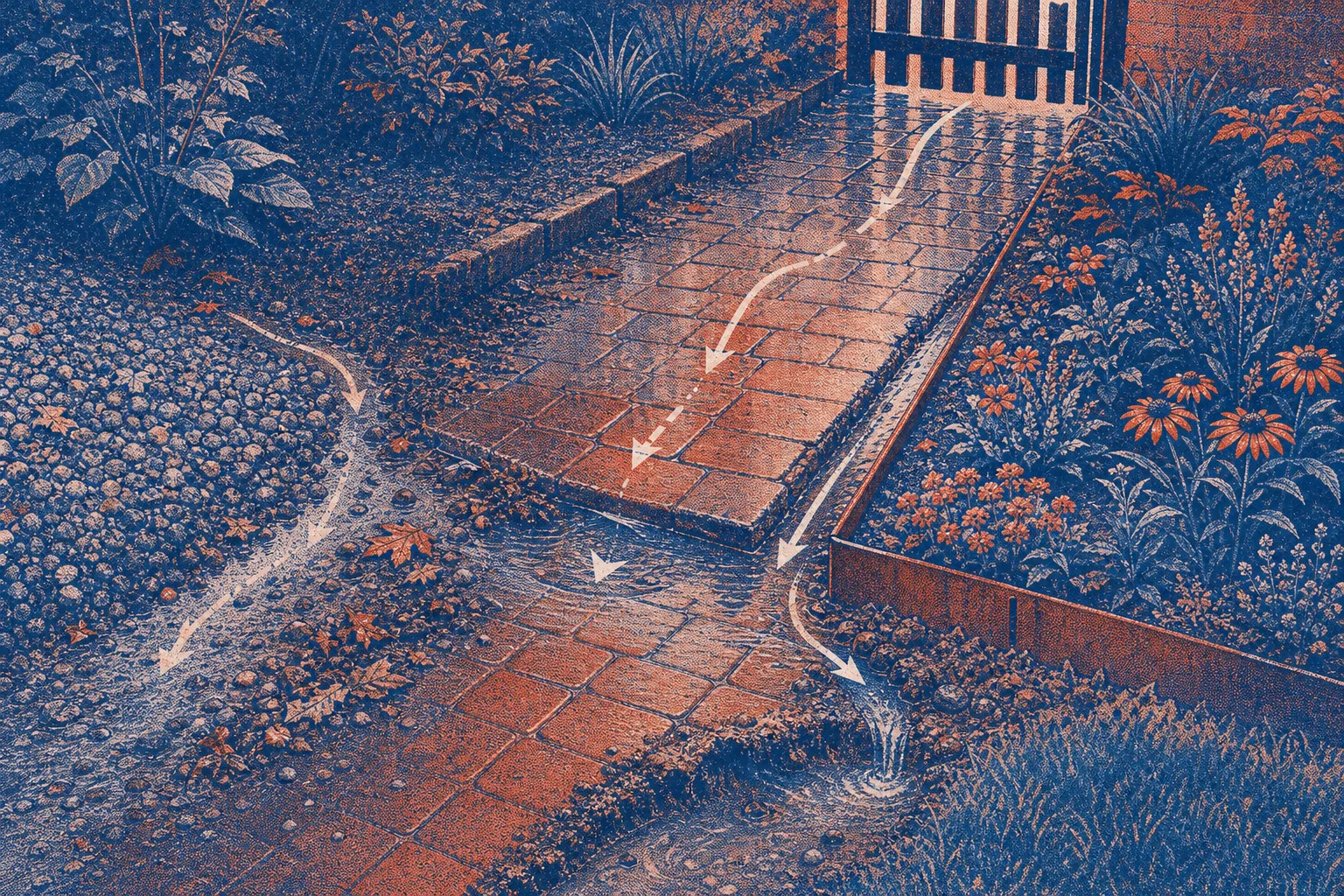
Rain on a garden path can soak through loose material, run toward a bed, collect in a dip, or leave the garden. To trace where rain goes after hitting a garden path, watch its surface and edges during or soon after rainfall; the route is easier to see while water is moving.
Check how the path surface handles water
Loose materials such as gravel, bark, and wood chips leave spaces that can admit water. What happens next depends on the material below: gravel over compacted subsoil may take in some water at the surface while directing the rest sideways.
Concrete, paving slabs, and tightly fitted bricks allow little water through their surfaces. Rain usually travels across them until it reaches a joint, an edge, or a low point. Permeable pavers have open joints and a base intended to receive water, but sediment-filled gaps or a compacted base can restrict that route.
After rain, look for standing water, damp patches, and wet edges. A persistent puddle may point to a shallow dip or blocked openings. Dampness below loose material shows that water has entered the surface, but it does not tell you whether the underlying ground is absorbing it or sending it elsewhere.
Follow the slope and watch the edges
Water runs downhill, but a path can steer it differently from the surrounding ground. A cross-slope may carry runoff toward a border; raised edging may hold it on the path or redirect it along the paving. A path that slopes toward a gate can carry rain away from planted areas.
Trace the route rather than judging only the center of the path. Watch where thin streams begin, cross an edge, or stop. Soil washed onto the paving and small deposits of grit can mark places where runoff repeatedly escapes from a bed or follows a channel.
Say you have a brick path that slopes toward a flower bed, but a raised metal edging strip blocks the way. Rain runs along the bricks and gathers at a low joint. Before altering the edge, identify the proposed outlet and check whether the water could affect a building, neighboring land, a public walkway, or an area prone to erosion. If the destination is uncertain or could create a drainage problem, leave the edging as it is and ask a qualified drainage professional to assess a safe route.
Read the soil and planting beside the path
Neighboring soil affects whether runoff soaks in or continues across the garden. Loose, open soil may absorb it readily; compacted ground may shed it. A surface crust, regular foot traffic, or a shallow clay-rich layer can slow absorption even when the bed looks dry at first.
Plant cover affects the route, too. Leaves and stems soften raindrop impact, while roots help create spaces in the ground. Bare soil beside a path is more exposed to splash and erosion, particularly where runoff arrives in a narrow stream.
Look for both signs of entry and signs of escape: a damp border, exposed roots, flattened mulch, or a fan of sediment. If water reaches the bed but does not soak in, sending more runoff to that spot may worsen erosion. Suitable organic mulch or reduced compaction may help; keep mulch clear of plant crowns and do not let it block the path edge.
Check dips, blockages, and the water’s destination
A low point can turn a path into a temporary basin. Water may collect where paving has settled, sections meet unevenly, or a wheel rut has formed in a loose surface. A shallow puddle is not automatically a problem, but repeated pooling can make a path slippery and leave nearby soil saturated.
Leaves, weeds, and sediment can block a narrow outlet. Check corners, drains, and gaps at the edge after rain. Clearing loose debris may restore an existing route, but it will not fix a poorly placed slope or settled low spot.
Follow runoff beyond the paving. It may enter a bed, cross a lawn or driveway, or gather near a wall. Water sent toward a building can cause dampness, and a fast stream across bare soil can carry away fine particles and mulch. If runoff could affect a foundation, neighboring property, public walkway, or other sensitive area, do not redirect it on guesswork; ask a qualified drainage professional about local conditions and a suitable outlet.
Not every puddle needs an elaborate fix. A brief pool that drains away and affects neither plants nor access may need no intervention; focus first on persistent pooling, a slippery walking surface, or water reaching an unsuitable destination.
What questions help explain the route?
How can I tell whether water is soaking in or draining away?
Watch for moving streams, surface puddles, and dampness along the edges as rain eases. Loose material may admit water at the surface, while the base determines whether it travels downward or sideways.
Why does water pool on a garden path?
A dip, uneven paving, blocked joint, or raised edge can interrupt the route. Check whether the pool recedes after rain and whether debris or a settled section may be holding it.
Should I direct path runoff into a garden bed?
Only consider that if the route is appropriate for the site and the bed appears able to receive water without erosion or harm to plants. If the flow could affect a building, neighboring land, or public space, do not redirect it yourself; seek qualified drainage advice.
Will gravel make a path drain better?
Gravel can let water pass through its surface, but the underlying material and condition of the gaps shape what happens next. Replacing only the top layer may not change the route if the base is compacted or the path carries water away.
Choose a modest response based on what you observe
Match any response to the visible cause, and do not alter a drainage route until you know where the water would go. Use these checks to decide what is reasonable:
- If loose leaves cover an existing open joint and the outlet leads to a known, suitable area, clear only the leaves; if the destination is uncertain, leave the route unchanged and seek advice.
- If a shallow rut holds water in loose material and filling it would not redirect runoff toward a structure or neighboring land, refill the rut; if the broader route is unclear, pause and consult a drainage professional.
- If a bed beside the path shows damp soil without exposed roots, washed-out mulch, or sediment deposits, observe it before making changes; if erosion or plant damage is visible, do not send it more runoff.
- If paving has settled and water repeatedly collects at the same joint, treat the paving as a separate issue; if lifting or resetting it could change the flow toward a sensitive area, get qualified advice first.
- If the path is slippery while pooled water remains, keep people off the affected section until it is safe to walk; if the cause is not an obvious loose blockage, arrange an appropriate assessment.
- If runoff appears to reach a wall, foundation, neighboring property, or public walkway, do not redirect or reshape the route; ask a qualified drainage professional to assess the destination and local constraints.
- If a puddle recedes and causes no apparent access or planting problem, leave it alone for now; if it persists or repeatedly affects the path or bed, record its location and seek advice before changing the route.
Imagine a path with one settled brick joint, a leaf-filled outlet at its edge, and a flower bed beyond it. At the start, water collects at the joint and stops at the leaves. The gardener notes the puddle, the blockage, the bed’s visible condition, and whether the outlet is near a wall or neighboring boundary. Because the outlet is assumed in this invented situation to lead only to an established planted area, the gardener clears the loose leaves without disturbing the bricks. During a later rain, the observable result is whether water passes the opening, enters the bed, or continues pooling at the joint. If it passes through and the bed shows no visible erosion, the gardener can conclude only that clearing the leaves changed the local route in those conditions—not that the route is safe in every storm. If pooling remains at the joint, the settled paving is still a separate issue; if water approaches a wall or other sensitive area, the gardener stops and seeks professional advice rather than adjusting the outlet.
A simple sketch can make the route easier to discuss: mark where water starts, collects, and exits, along with any damp soil or sediment. Note the conditions you observed, but treat a single rainfall as a local snapshot, not proof of how the path will behave in heavier rain or at another time. That record can help distinguish a visible surface blockage from a destination question that needs professional judgment.
Nearby ground

The Jar Test Is a Clue, Not a Soil Verdict
A soil jar test gives a rough visual comparison of sand, silt, and clay layers, helping…
How to Match Root Depth and Spread to Garden Space
Match root depth and spread to beds, containers, and neighboring crops to choose a planting place…